

Strategy leadership
An article in the 'Leading Strategy' series


In this last article in this series for organisational leaders (and others) I am going to explore some of the elements of leading strategy in organisations (and it’s much more than the stereotypical image of the ‘hero’ leader devising a brilliant strategy that outwits and outflanks the competition and leads to glowing success for the business).
It is very easy to focus just on ‘the strategy’ that an organisation adopts as the key output of the strategy responsibilities of the organisation’s leaders, and judge this by what happens to the organisation subsequently:-
has the strategy that it was the leaders’ responsibility to decide upon been the right choice?
did the organisation implement it succesfully?
have the organisation’s performance and results been what was expected and hoped for?
There is a retrospective framing to these questions, whereby what has actually transpired is the vantage point from which the organisation’s strategic choices are assessed, and leaders’ strategy abilities judged. Yet there are so many factors and events that influence what happens within an organisation and around it in its ‘market’ or industry or socio-economic environment: assigning causality only to a particular strategy decision underestimates the effect that some of these might have had.
I took part recently in the International Association for Strategy Professionals UK’s annual Strategy Debate, which this year was about the motion, The role of luck and serendipity are underestimated in strategy. It was a fascinating discussion, and it brought to life the limitations of thinking that if strategies don’t result in what had been hoped for then that is a result of poor decisions or flawed execution: “We should have made better strategy decisions and worked harder at making our strategy happen”. Such views reflect an organisation-centric perspective that is based on the implicit assumption that an organisation can determine its own future, and not achieving that is due to some degree of failure by the organisation.
Accepting that circumstances and happenings outside of the organisation can have a significant effect on what actually happens to the organisation opens out the thinking about strategy, encouraging a wider view of the organisation’s relationships in its broad ecosystem and recognising their potential to influence developments.
As the discussion progressed it became apparent that we had shifted from a retrospective view of assessing strategy to a forward-thinking perspective about how the organisation considers what might influence its future and how it can sense and adapt to whatever changes, opportunities or threats unfold - an anticipatory mindset including the flexibility to respond.
I would argue that strategy leadership is actually more about developing such strategy capabilities in an organisation than formulating ‘perfect strategy’.
There are three key aspects of strategy leadership:-
helping the organisation build and strengthen its strategy capabilities
ensuring that there are the spaces, processes, engagement and energy - and the rich conversations - within the organisation to use these effectively to guide the organisation’s strategy journey
assessing and achieving a consensus about when to use these processual strategy capabilities to assess and adjust the next stages in such a journey - for example, to focus on a challenge or a critical question, to assess possible changes, or to generate renewed energy towards a shared purpose.
- it’s really about enabling and ensuring the flow of strategy and making it ongoing and dynamic in the organisation.
That is no easy task - but it’s not an impossible one either. When I was developing my ideas about strategy capabilities a few years ago I interviewed several organisational leaders, and one of the observations that stood out for me was how some of them were working with their colleagues across their organisation on a ‘learning journey’, thinking about various aspects of strategy and considering collectively how they might apply this in their organisation, steadily developing a shared understanding and - importantly - the confidence to have open conversations about strategy.
Again, it’s that willingness to learn and develop - individually as a leader and collectively as an organisation - that is key. (As Professor Jeff Gold and Alaa Garad write in their book The Learning-Driven Business (Bloomsbury, 1921), “Learning is the only sustainable competitive and collaborative advantage that an individual, and organization or a government can have.”)
Approaching strategy as a learning journey for the organisation - one in which it is continually working to develop and strengthen its strategy capabilities - requires a different (and humbler) mindset than the more ‘traditional’ deterministic control-from-the-top view about a leader’s role and responsibilities in their organisation’s strategy.
The realisation is growing that organisations need a wider perspective of strategy if they are to cope better with the uncertainties of the future, and this goes much deeper than acquiring scenario planning skills or occasional strategic foresight inputs to their strategic planning workshops. (As my work on strategy capabilities has developed I have become increasingly interested in the role that mindsets (‘worldviews’) play in how organisations approach strategy - but that is for a future article!)
Strengthening organisational strategy capabilities in this way is much broader than focusing just on strategic thinking and strategic management skills. As Eva Tomas Casado and I wrote in our article in The European Business Review earlier this year:
”There are three key aspects that organizations need to consider in developing a more dynamic approach to strategy:
How strategy ‘flows’ in their organization: the conversations, processes and engagement that occurs in their ‘Strategy Work’, including considering multiple possibilities and anticipating and responding to any changes in the organization’s ‘ecosystem’, continuously adapting decisions and actions as situations evolve.
How the organization considers multiple possible futures and their implications and integrates this ‘Futures Work’ into their strategic thinking. This is more than strategic foresight and scenarios planning: the goal is to become more confident in uncertainty and to develop an anticipatory mindset. By embracing futures as a resource organizations become more resilient and adaptive.
How it cultivates the organizational culture (the environment, relationships and values) that enables and supports the organization’s approach to strategy and futures – how people are engaged in strategy and supported in decisions and risk-taking, and fostering continuous learning to create an environment where adaptability is sustainable rather than draining.”
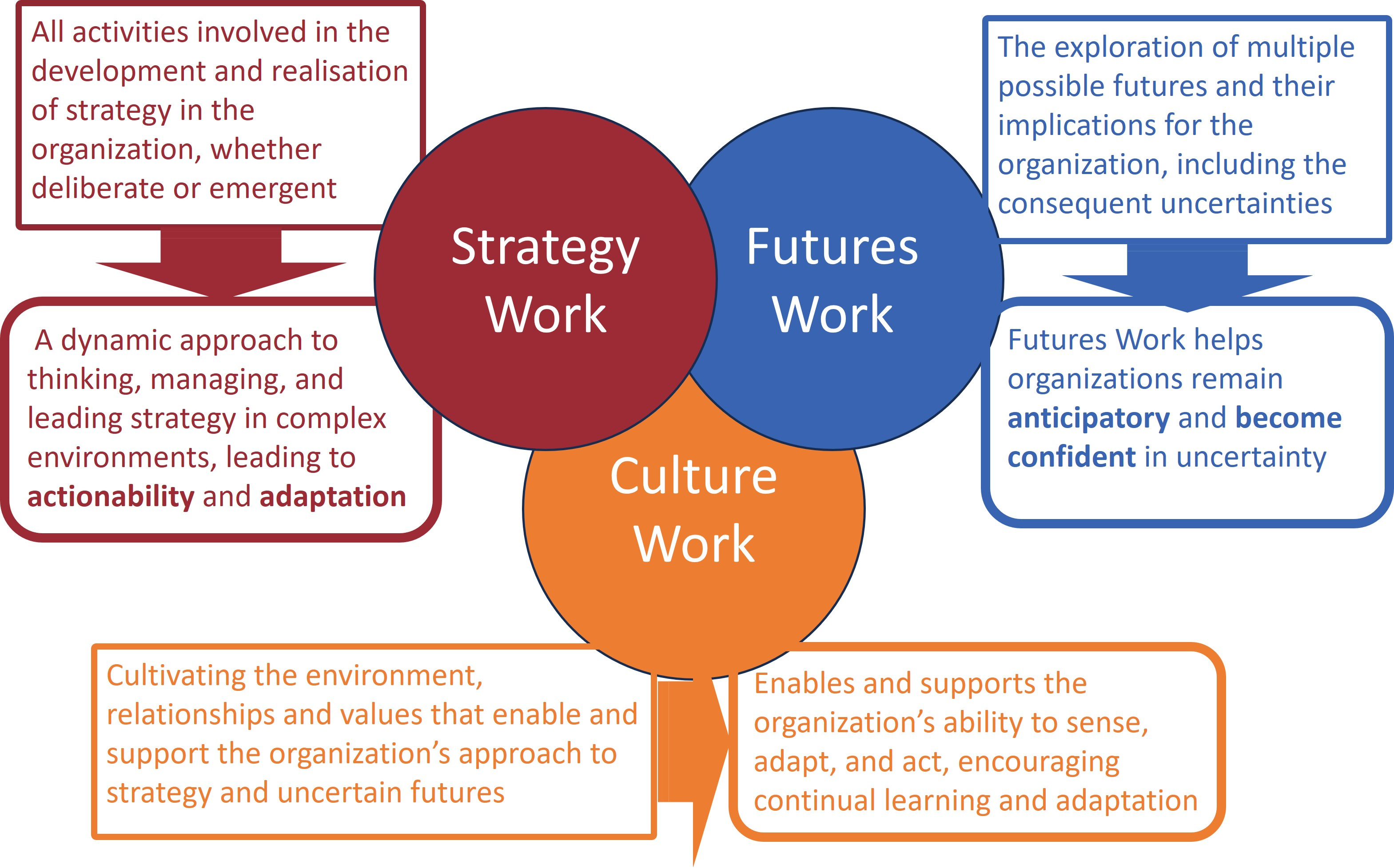
(In the article we outlined ten interconnected ‘building block’ capabilities that could help as a framework for organisations to consider how they might approach this, looking at it as a journey of continual development and learning from the experience of putting these into practice - iterative steps that together help cultivate a more adaptive and responsive approach to strategy over time.)
Strengthening these capabilities in an organisation is a key element of strategy leadership: it is how the organisation can be more prepared to be able to deal with whatever changes might occur. It is an approach of continual learning and development, of strengthening, enabling, and guiding the organisation dynamically as it works out the next stage of its strategy journey.